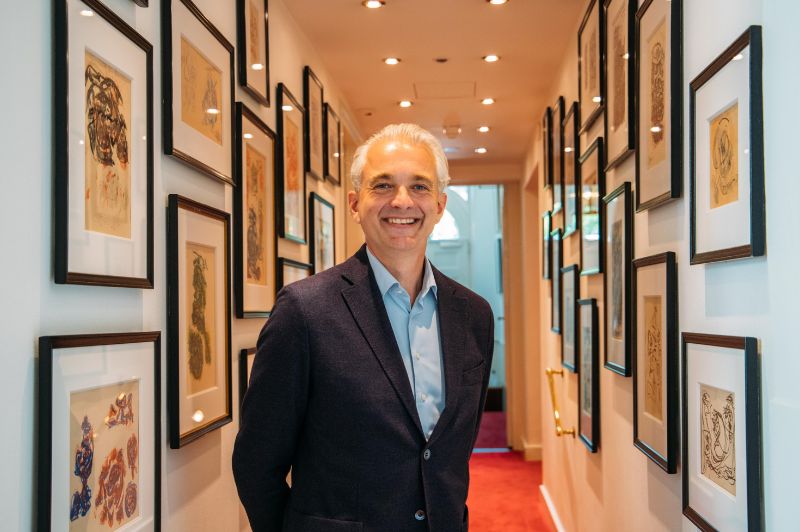
Eduard Janssen
Private guide in Amsterdam — history, art, culture, and city exploration.
After completing an MSc in Real Estate at Kingston University London, Eduard worked with several international commercial real estate firms. He combines his industry expertise with a passion for urban development, history, and art to create a unique hospitality experience.
Having lived in Amsterdam's historic canal district for 25 years, Eduard believes that our perspective on history shapes how we view the present. He is committed to providing every client with reliable, friendly, and expert service.
The canal district is the ideal starting point for interesting tours with Eduard, which are personal and tailored to the pace, wishes, and interests of his clients.
A conversation with Eduard
Eduard, what does it mean to you to guide clients through Amsterdam?
The canals, Dam Square, streets, and courtyards all invite exploration. So do the city's many museums, such as the Rijksmuseum and the Van Gogh Museum. Many locations, individuals, and even works of art have a story to tell — stories of joy, but also of sadness.
You constantly connect past and present. Why is that so important?
World-famous books have been written about Amsterdam's rich history. For entrepreneurs, scientists, economists, and politicians, this legacy provides the essential tools to navigate a rapidly changing world. But where does this wisdom originate? Amsterdam's strategic location and infrastructure have forged it into a global trade hub and a vibrant melting pot of culture, creativity, and social cohesion. Throughout the centuries, its people and institutions have maintained a steadfast commitment to human rights, housing, and social services.
The signature image of the city. Why is it so special?
I have been living in the canal district for 25 years now, specifically in one of the 'Nine Streets'. Built during the Golden Age, the canals and canal houses reflect both the economic boom of that era and a complex history of trade and colonial exploitation, as well as the relative freedom of religious groups, publishers, and thinkers. A visit to the nearby Jordaan district is also highly recommended; it is a picturesque neighbourhood with a strong folk culture.
What forces do you think have shaped Amsterdam?
The Alteration of 1578 brought about a religious and political upheaval. Due to its relative tolerance and freedom, Amsterdam became a haven for many immigrants. The Peace of Münster and the Treaty of Westphalia in 1648 strengthened Amsterdam as an international trade centre and laid the foundation for the map and political system of Europe. Jewish identity is also inextricably linked to the city; its nickname 'Mokum' (derived from the Hebrew Makom, meaning 'place') reflects this deep connection to Amsterdam as a historic centre.
Amsterdam was once the financial capital of the world. How does that legacy show itself today?
Few cities can claim to have invented the instruments of modern finance. In 1602, the Dutch East India Company — the VOC — became the world's first publicly traded company, issuing shares to citizens across the republic. To trade those shares, the Amsterdam Stock Exchange was established in 1611, making it the oldest in the world. Around the same time, the Bank of Amsterdam — the Wisselbank, founded in 1609 — pioneered what we would recognise today as central banking: a stable currency, deposit accounts, and the clearing of international payments. Merchants, scientists, and philosophers came to Amsterdam not only for freedom of thought, but for capital. The Golden Age was not simply a cultural flowering — it was fundamentally a financial one. When you walk the Herengracht or stand at the Dam, you are moving through streets that once financed the world. That history is still visible in the architecture, if you know where to look.
Does a tour always go through the historic centre, or do you also explore the more modern parts?
Yes, cycling often offers a great solution. Take the NDSM wharf in Amsterdam-Noord, for example: this site has been transformed from an old shipyard into a vibrant cultural hub for artists and events. Zuidas is an area where major financial and legal institutions are located and is still under development.
Is there a place in Amsterdam that brings everything together for you?
Dam Square is historically the most important location in the city. It is the place where Amsterdam was created by the construction of a dam in the Amstel and represents the struggle with the water. The Dam grew into the beating heart (financially), where administrative and religious buildings were erected. Dam Square now serves as the national symbolic focal point for commemorations and ceremony.
If you could give one thought to someone walking through the city, what would it be?
Amsterdam's motto is: 'Valiant, Steadfast and Compassionate'. These values are fundamental to the city's ongoing transformation into an attractive, innovative, and international hub for its residents, businesses, and institutions.
A personal promise
Eduard offers unique, high-quality tours for private and professional clients. His customised programmes provide an authentic experience of Amsterdam's rich art and cultural history.
His personal promise to all clients is to provide a reliable, friendly, and expert service. The longstanding relationship he enjoys with, for example, the prominent Ambassade Hotel in Amsterdam reflects the fact that he more than meets this commitment.
His respect for fellow human beings means he does not accept work where he feels this is not the case.